Position Sizing Basics: Risking a Fixed Percentage
Two traders can take the same trade with the same entry, stop and target, and have completely different outcomes because they sized the position differently. Position sizing decides how much of your account a single mistake can cost, and that is why many experienced traders consider it more important than entry timing. This article explains the fixed-percentage method, step by step.
The idea: risk a fixed share of the account
Instead of buying "a standard lot" or "100 shares" every time, you decide how much of your account you are prepared to lose if the trade is stopped out. Many traders choose a small, constant percentage, commonly somewhere between 0.5 and 2 percent, though the right figure depends on your own situation and tolerance. This article uses 1 percent for the examples. It is an illustration, not a recommendation.
The position size is then whatever makes the loss at your stop equal to that amount.
The formula
Position size = amount you are willing to risk / risk per unit
- Amount you are willing to risk = account size x risk percentage
- Risk per unit = distance from entry to stop, in price terms per share, contract or pip value
Worked example with shares
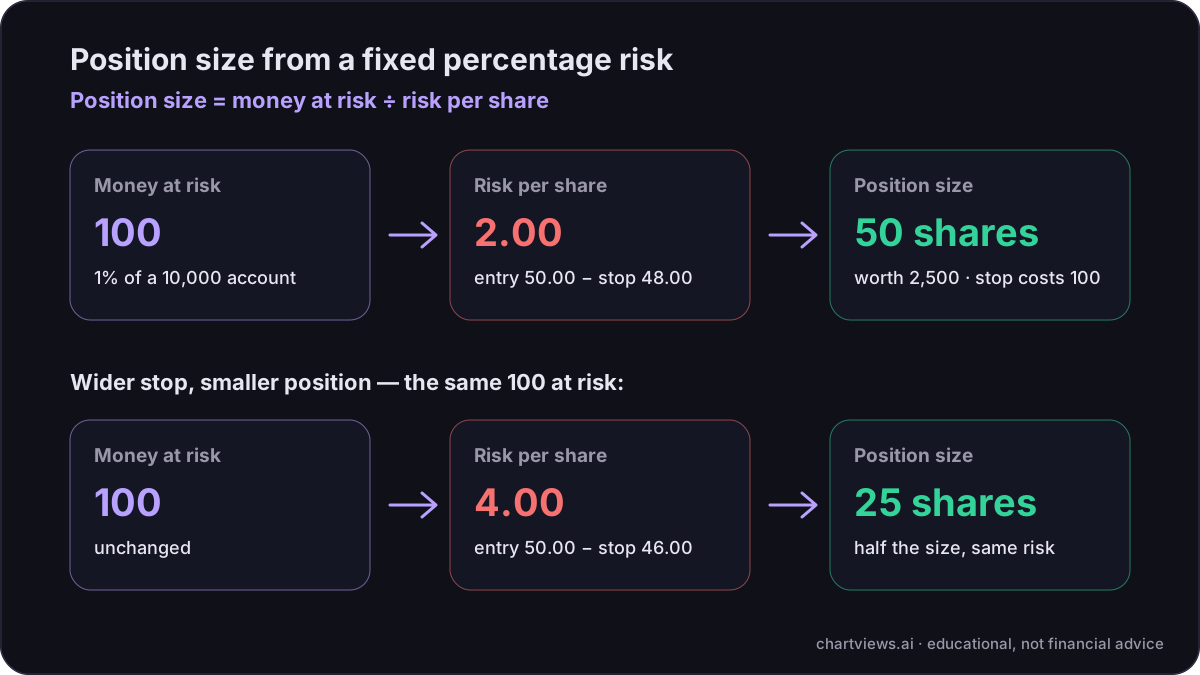
Account: 10,000. Risk per trade: 1 percent, so 100.
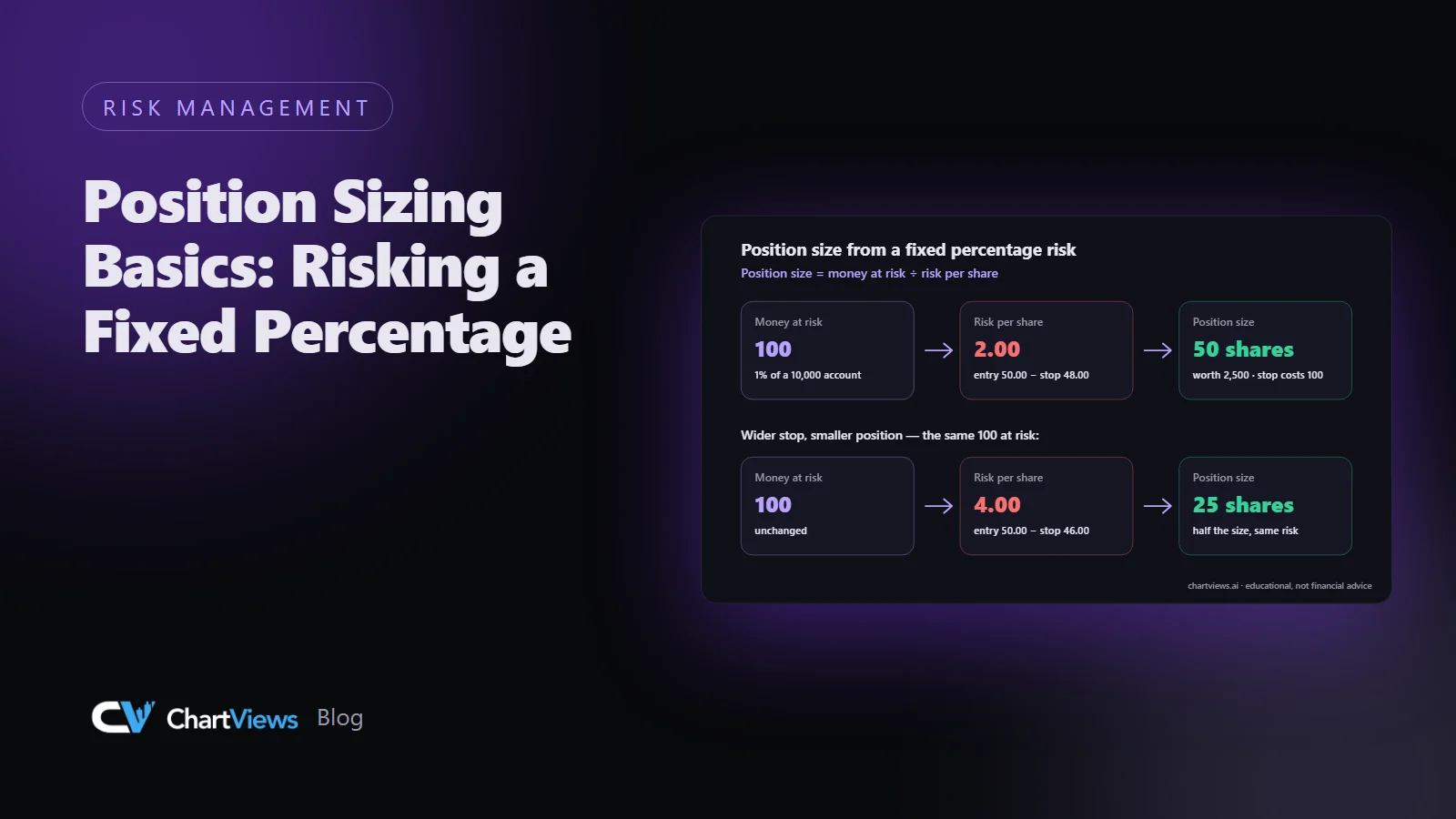
A trader plans to buy a stock at 50.00 with an invalidation level and stop at 48.00. The risk per share is 2.00.
- Position size = 100 / 2.00 = 50 shares
- Position value = 50 x 50.00 = 2,500, a quarter of the account
If the stop is hit, the loss is about 100, or 1 percent. If instead the stop were wider, at 46.00, the risk per share would be 4.00 and the position would be 25 shares. A wider stop leads to a smaller position, and the dollar risk stays constant. That is the whole point.
Worked example with forex
Account: 5,000. Risk per trade: 1 percent, so 50.
A trader plans to buy a currency pair with a stop 40 pips away. If one pip on a standard lot is worth about 10 in the account currency (this varies by pair and account currency, so check your platform), then one lot would risk 400 and a mini lot (0.1) would risk 40.
- Risk per pip allowed = 50 / 40 = 1.25
- That corresponds to about 0.125 lots, which you would round down to the nearest increment your broker allows, such as 0.12
Always round down, not up, so the loss at the stop does not exceed your limit.
Why a fixed percentage works
- Survival. A series of losses is inevitable in any approach. At 1 percent risk, ten consecutive losing trades cost roughly 10 percent of the account, which is painful but recoverable. At 10 percent per trade, the same streak would cost about 65 percent and require a gain of roughly 187 percent to get back to even.
- Recovery maths. The deeper a drawdown, the harder it is to recover: a 50 percent loss needs a 100 percent gain to break even. Keeping losses small keeps the maths on your side.
- Consistency. The same dollar risk on every trade makes results easier to compare and reduces the temptation to bet big after a win or to try to win back a loss.
- Automatic scaling. As the account grows or shrinks, the dollar amount at risk follows, without extra decisions.
Mistakes to avoid
- Sizing by feeling. Going bigger because a setup "looks perfect" is how large losses happen.
- Ignoring the stop distance. Using the same number of shares or lots regardless of stop width means your risk changes every trade.
- Forgetting costs and gaps. Spreads, commissions and slippage add to your loss, and a stop is not guaranteed to fill at the exact price. Overnight or news gaps can produce losses larger than planned. This is a reason to risk less, not more.
- Stacking correlated trades. Three long positions in currency pairs that all share the same base currency may behave like a single large trade. Treat correlated positions as one risk when you add them up.
- Moving the stop to fit a size. If the stop that makes sense on the chart gives a position too small to be interesting, accept the small size or skip the trade. Do not tighten the stop to inflate the position.
- Over-leveraging. Leverage lets you hold large positions with small margin, but it does not change how much you lose when the stop hits. Size from risk, not from available margin.
Adjusting the percentage
Some traders reduce their risk after a losing streak or when volatility is unusually high, and keep it standard at other times. Others hold it constant on purpose. What matters is that the rule is set in advance and not improvised during a drawdown. Beginners often start with a smaller percentage than the example here while they learn how their strategy behaves.
A short pre-trade checklist
- Account size and risk percentage, giving the money at risk.
- Entry and invalidation-based stop, giving risk per unit.
- Position size from the formula, rounded down.
- Check the total open risk across all positions.
- Check the risk-reward ratio of the resulting trade (see our article on the risk-reward ratio).
An analysis report from ChartViews AI gives you the entry, stop-loss and targets that you can feed into this calculation. The sizing decision, however, always remains yours, and it should reflect your own finances and risk tolerance. To see a trade plan laid out, you can run a free analysis: try a free analysis.
Educational content, not financial advice. Trading involves risk of loss.
 Money Circle Blog
 Trader Reflect Blog