AI Trading vs Manual Trading: Which Wins?
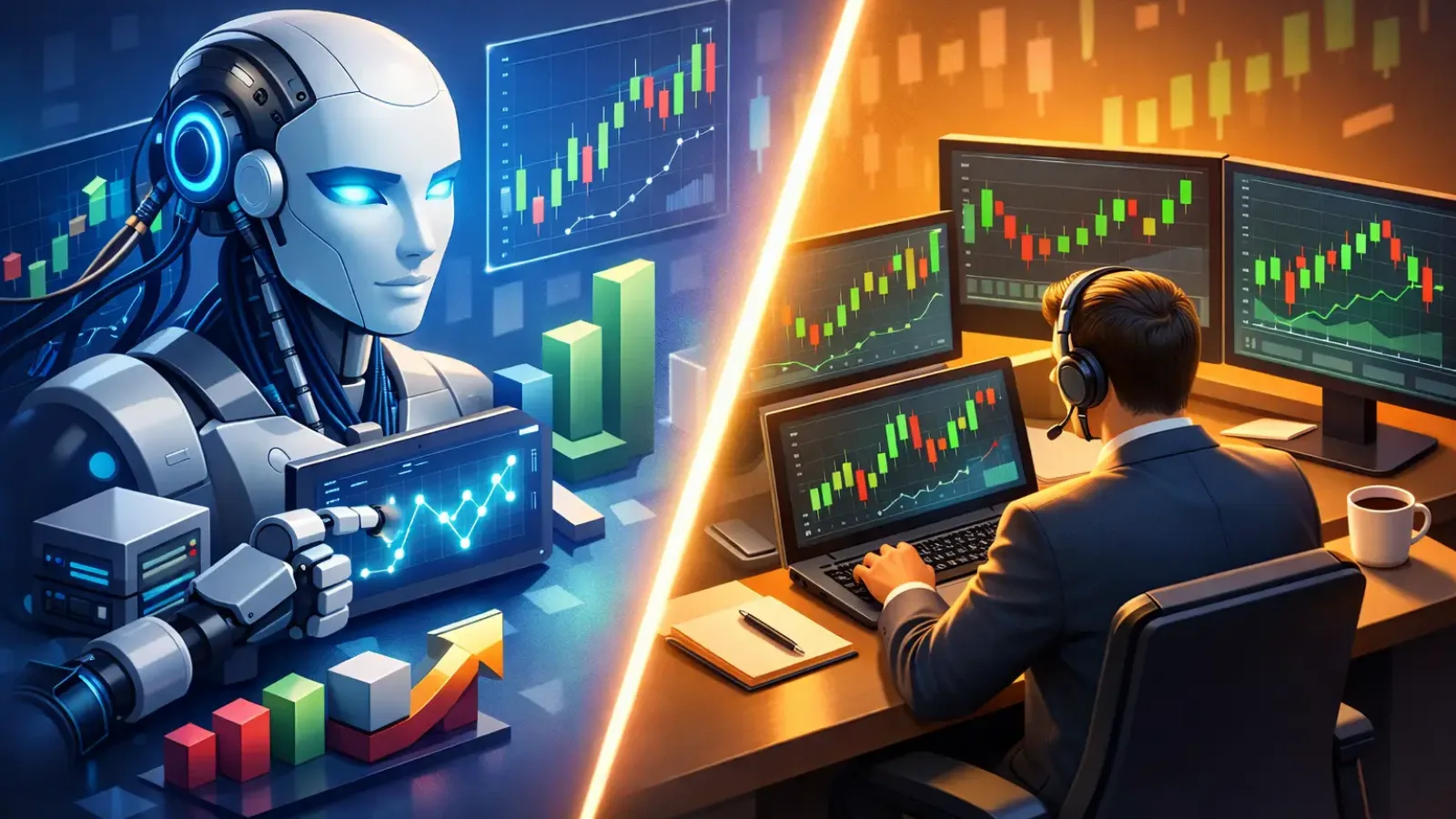
Most traders do not lose because they lack opinions. They lose because they process too slowly, second-guess their own chart reads, or act on emotion after the setup has already changed. That is why the real debate around ai trading vs manual trading is not about hype. It is about execution quality under pressure.
For active traders, the difference matters. Every method shapes how fast you spot a trend, how consistently you mark support and resistance, and how disciplined you stay when price starts moving. AI can compress analysis time and add structure. Manual trading can bring context, discretion, and market feel. Neither is automatically better in every situation.
AI trading vs manual trading in real market conditions
AI trading is built for speed and repeatability. It can scan patterns, identify key levels, and produce structured analysis in seconds. That matters when you are reviewing multiple charts, trading fast markets, or trying to avoid analysis paralysis. Instead of staring at a chart for ten minutes and still feeling uncertain, you get an immediate framework for what price is doing and where the important levels may be.
Manual trading works differently. It relies on your own chart reading, experience, and judgment. A skilled manual trader can spot nuance that a rules-based system may miss, especially around unusual market behavior, news-driven moves, or context that does not fit a clean pattern. The trade-off is obvious. Manual analysis takes more time, and the quality of that analysis can vary from one session to the next.
In practice, most traders are not choosing between pure automation and pure discretion. They are choosing how much of their decision process should be accelerated, standardized, or left to personal judgment.
Where AI trading has the edge
The strongest case for AI is consistency. Traders often know what a good setup looks like, but they do not apply that standard the same way every time. Fatigue, hesitation, and bias all creep in. AI does not get bored on the fifth chart review of the night. It does not move a support level because it wants a trade to work.
That makes AI especially useful in chart-heavy workflows. If you trade stocks, forex, or crypto and review multiple setups a day, AI can reduce friction fast. It can highlight trend direction, key support and resistance zones, and possible entry and exit areas without forcing you to manually map every chart from scratch. For traders who struggle with overanalysis, that alone is a serious advantage.
AI also helps beginners close the gap faster. Newer traders often know basic technical concepts but have trouble applying them consistently on live charts. Structured AI analysis can make the chart easier to read and remove some of the guesswork. Instead of wondering whether a level matters, they start with a clearer framework and can focus on decision quality.
This is where a platform like ChartViews AI fits naturally. It turns chart review into a faster, more repeatable process by analyzing uploaded charts and identifying trends, support, resistance, and trade levels in seconds. For traders who want quicker technical reads without doing every step manually, that kind of workflow matters.
Where manual trading still matters
Manual trading remains valuable because markets are not always clean. Price can react to macro events, earnings, liquidity shifts, or sentiment changes that break a textbook setup. An experienced trader may recognize when a chart looks technically valid but feels weak because the broader context does not support the trade.
That kind of judgment is hard to reduce to a simple output. Manual traders can also adapt more fluidly when conditions change. They may decide to pass on a setup that looks good on paper because volume is fading, the move is overextended, or the risk-reward no longer makes sense after a sudden spike.
There is also a psychological point here. Some traders perform better when they are fully engaged in the analysis process. If they outsource too much of the read, they may follow signals without conviction or ignore risk management because they assume the machine is more certain than it really is. AI can sharpen a process, but it should not replace accountability.
The real weakness of AI trading
AI is fast, but speed can create false confidence. If traders treat AI output as a guaranteed answer instead of structured decision support, they are likely to misuse it. Markets remain probabilistic. A chart analysis tool can improve clarity, but it does not remove uncertainty.
There is also a difference between identifying a setup and managing a live trade. Entry, scaling, stop placement, and exit decisions often depend on risk tolerance and execution style. Two traders can use the same analysis and produce very different results because they size differently or respond differently once the trade is active.
So the weakness is not that AI cannot analyze charts. It can. The weakness appears when traders stop thinking critically and assume faster analysis means perfect analysis.
The real weakness of manual trading
Manual trading sounds appealing because it feels personal and skilled. But for many retail traders, manual analysis is exactly where performance breaks down. They redraw levels, chase bias, hesitate at the trigger, and reinterpret the chart after price moves. That creates inconsistency.
Manual trading is also slower by nature. If you are reviewing ten or twenty charts in a session, the cost of that extra time adds up. You either rush and make weaker decisions, or you miss opportunities because the setup is gone before you finish your review.
This is the part many traders overlook. The issue is not whether manual chart reading can work. It can. The issue is whether you can apply it with the same discipline every day, across multiple markets, without fatigue or emotional drift. That is a much harder standard.
AI trading vs manual trading for different trader types
If you are a beginner, AI often gives you a faster path to structure. It can help you identify what matters on a chart and reduce random decision-making. That does not mean you should stop learning technical analysis. It means you can learn with a more consistent frame of reference.
If you are an intermediate trader, AI can tighten your process. This is often the group that benefits the most because the basics are already there, but execution is uneven. Faster analysis and clearer levels can improve discipline and reduce hesitation.
If you are an experienced discretionary trader, manual trading still has an edge in contextual judgment. But even then, AI can save time. It can act as a first-pass review, a confirmation layer, or a way to process more setups without sacrificing consistency.
The best approach is usually hybrid
The strongest trading workflow is often not ai trading vs manual trading as an either-or choice. It is AI for speed and structure, then manual judgment for confirmation, risk control, and final execution.
That approach keeps the best parts of both methods. AI handles repetitive chart analysis quickly and consistently. The trader decides whether the setup fits the broader context, account risk, and current market conditions. You move faster without becoming careless.
This matters because trading performance is rarely destroyed by a lack of tools. It is destroyed by inconsistency. A hybrid process reduces that problem. You can review more charts, identify stronger levels, and still keep human discretion where it matters most.
So which one wins?
If the goal is pure speed, AI wins. If the goal is nuanced interpretation in unusual conditions, manual trading still has advantages. If the goal is better real-world execution for most active retail traders, the winner is the method that improves discipline without removing judgment.
For many traders, that means using AI to get to a clean, structured read faster, then making the final decision with clear risk parameters. That is not a compromise. It is a performance upgrade.
The traders who improve fastest are usually not the ones trying to prove they can do everything manually. They are the ones building a process that helps them read charts clearly, act decisively, and stay consistent when the market gets noisy. That is the standard worth aiming for.
Educational content, not financial advice. Trading involves risk of loss.
 Money Circle Blog
 Trader Reflect Blog