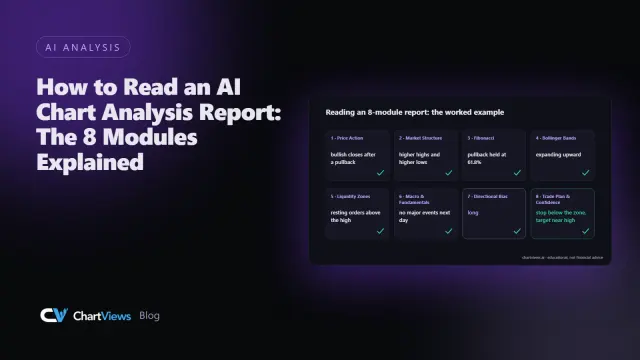
AI Stock Analysis Review for Active Traders

A stock setup can look clean at 9:30 and completely questionable by 9:37. That gap between spotting a move and second-guessing it is exactly where an ai stock analysis review matters. For active traders, the real question is not whether AI sounds impressive. It is whether it helps you read charts faster, identify better levels, and make more disciplined decisions when the market is moving.
What an ai stock analysis review should actually measure
Most reviews get distracted by surface-level claims. They focus on whether a tool is "smart," how many indicators it references, or whether the interface looks polished. Traders need a more practical standard.
A useful AI stock analysis tool should shorten the path from chart to decision. That means identifying trend structure, highlighting support and resistance, and giving you a clearer view of possible entry and exit areas. If the output adds noise, repeats obvious observations, or feels too generic to trade from, the tool is not doing its job.
Speed also matters, but only if the analysis has structure. Fast output without clear market logic is just faster confusion. The best tools reduce hesitation by organizing what the chart is already saying in a way that is easier to act on.
Where AI stock analysis performs well
AI is strongest when the task is repeatable and visual. Technical chart review fits that well. Price structure, momentum context, obvious reaction zones, and breakout or breakdown areas are all patterns that can be assessed consistently when the system is built for chart interpretation.
This is especially useful for traders who scan multiple tickers, sectors, or timeframes every day. Manual analysis becomes slow when you are flipping through chart after chart trying to confirm trend direction and key levels. AI can compress that workflow into a few seconds and give you a more standardized starting point.
For newer traders, that structure can also reduce one of the biggest problems in technical analysis - inconsistency. A beginner might mark support one way on Monday and a completely different way on Thursday, even on similar setups. AI helps enforce a more repeatable review process. It does not replace learning, but it can reduce random interpretation.
For experienced traders, the value is slightly different. They often do not need the basics explained. What they need is speed, confirmation, and a second layer of analysis that keeps them from missing obvious levels while managing several markets at once.
Where AI stock analysis still falls short
Any honest ai stock analysis review has to include the limits. AI can read structure, but it does not understand market context the way a disciplined trader does. It can point out trend and zones, yet still miss why a setup is weaker ahead of earnings, broad market instability, sector rotation, or unusual liquidity conditions.
It can also sound more certain than it should. This is a real risk. Markets are probabilistic, and chart analysis is never exact. If an AI tool presents every setup with the same level of confidence, traders can become less critical right when they should be more selective.
Another issue is overgeneralization. Some AI outputs are technically correct but not useful. Saying a chart is in an uptrend with resistance overhead is not enough if the levels are too broad or the trade idea lacks precision. Traders need actionable analysis, not commentary that could apply to almost any chart.
That is why the quality of the output matters more than the presence of AI itself. If the tool cannot convert chart data into structured decisions, it is closer to content generation than trading support.
The features that matter most in an AI stock analysis review
The best evaluation standard is simple. Does the platform help you make faster, clearer decisions from the chart in front of you?
A strong tool should identify trend direction without forcing you to interpret every price swing yourself. It should mark support and resistance in a way that feels relevant, not random. It should also frame potential entry and exit areas with enough specificity that you can judge risk versus reward instead of staring at the chart and redrawing lines for ten minutes.
Usability matters more than traders sometimes admit. If the workflow is slow, cluttered, or requires too many steps before you get insight, adoption drops fast. Traders want a direct process. Upload the chart, get the analysis, review the levels, and decide whether the setup deserves attention.
This is where platforms built around chart ingestion have an edge. Instead of asking traders to build an analysis from scratch inside the app, they let traders bring in the chart they are already watching and turn it into a structured review. That keeps the process aligned with real trading behavior.
How active traders should use AI without becoming dependent on it
The right way to use AI is as a decision-support layer, not a substitute for judgment. That distinction matters. If you rely on AI to tell you what to buy and sell with no personal process behind it, you will eventually follow a weak setup with too much confidence.
A better workflow is to treat AI as an accelerator. Start with your watchlist or chart scan. Run the strongest candidates through AI analysis. Use the output to confirm structure, tighten your levels, and spot anything you overlooked. Then apply your own rules for entries, invalidation, position size, and risk management.
This approach protects you from two common mistakes. First, it prevents analysis paralysis by giving you a cleaner initial read. Second, it prevents blind trust by forcing the final trade decision through your own system.
For beginners, this can create a more disciplined learning loop. You compare your read of the chart with the AI output and look for patterns in where you agree or miss key levels. For intermediate traders, it becomes a consistency tool that helps remove hesitation. For advanced traders, it is often most valuable as a time-saving confirmation layer.
A practical AI stock analysis review standard
If you are comparing platforms, ask a few hard questions.
Does the analysis feel specific to the chart, or could the same text be pasted onto twenty different setups? Does it identify levels clearly enough to support a real trade plan? Does it improve your workflow in seconds, or create another layer of friction? And most importantly, does it help you make better decisions under time pressure?
That last point matters most. Trading tools are easy to like when the market is calm. Their real value shows up when volatility rises, multiple setups are competing for your attention, and hesitation starts costing you entries. In that environment, structure beats novelty every time.
A platform like ChartViews AI fits this use case when it delivers what active traders actually need - instant AI-powered analysis from a chart upload, with clear trend identification, key support and resistance, and actionable trade zones. That is not about replacing technical analysis. It is about making technical analysis faster, more repeatable, and easier to execute consistently.
Is AI stock analysis worth it?
For most active traders, yes - with one condition. The tool has to improve chart review in a practical way. If it saves time, sharpens your level marking, and reduces indecision, it is valuable. If it produces vague observations or pushes false confidence, it is just another distraction.
The strongest case for AI is not that it predicts the market. It is that it helps traders process chart information with more speed and structure. That is a meaningful edge for anyone reviewing multiple setups or struggling to stay consistent from one trade to the next.
The trade-off is simple. AI can improve discipline, but only if the trader still owns the final decision. Used well, it becomes a force multiplier for technical analysis. Used carelessly, it becomes outsourced conviction.
The traders who get the most from AI are usually the ones who want less noise, faster chart review, and a cleaner path from setup to execution. If that sounds familiar, the right tool is not the one making the biggest promises. It is the one that helps you see the chart clearly enough to act with confidence when timing matters most.
Educational content, not financial advice. Trading involves risk of loss.
 Money Circle Blog
 Trader Reflect Blog