
Invalidation: Where a Trade Idea Stops Being Valid
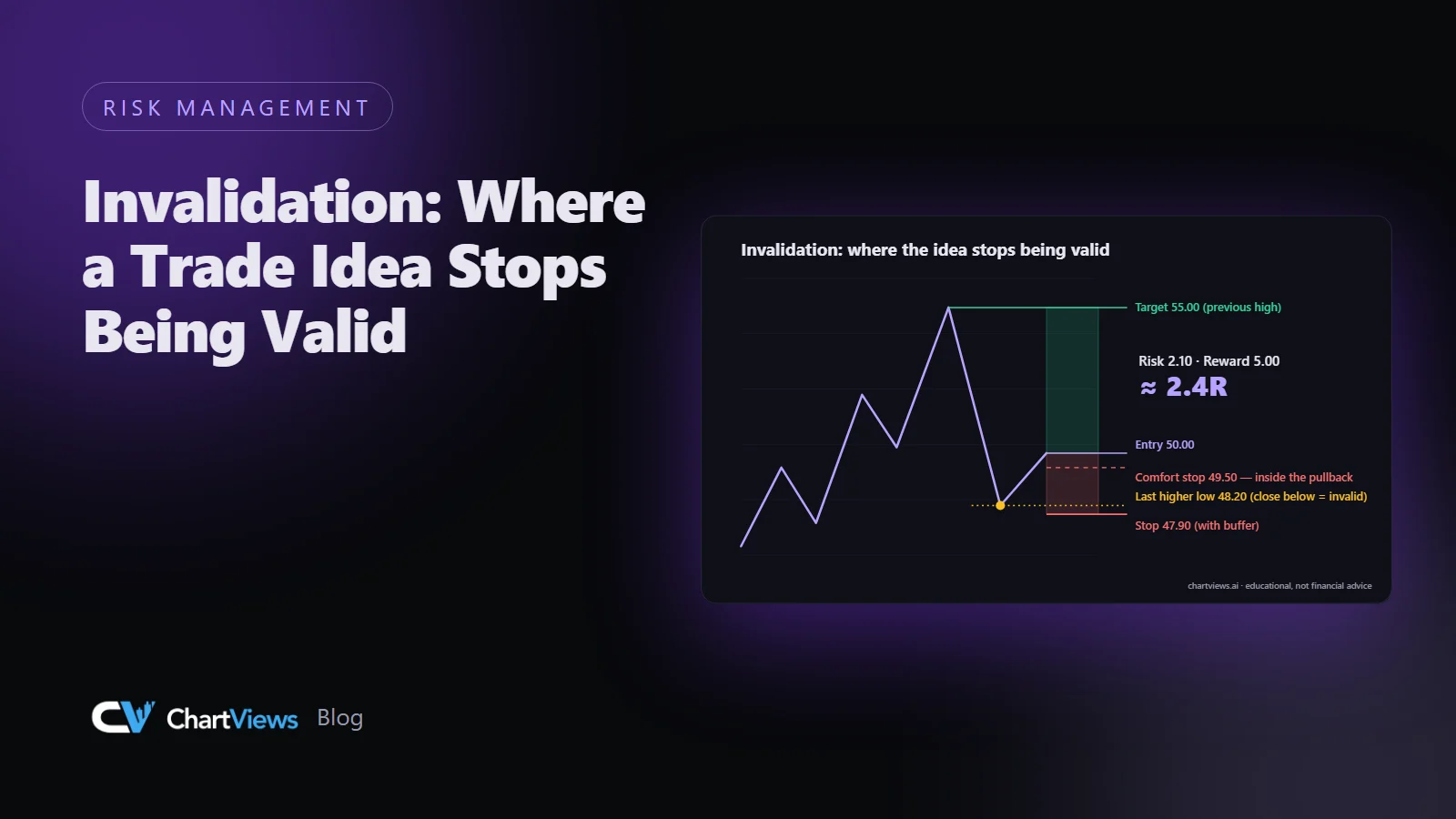
Most traders spend their time on the question "how far can this go?" The better question is "where am I wrong?" Invalidation is the price at which the reason for a trade no longer exists. Defining it before you enter is one of the most useful habits in trading, and it matters more than the target for a simple reason: the target is a hope, while the invalidation is a decision you can actually control.
What invalidation means
Every trade idea is a claim. "Price is in an uptrend and pulling back to support, so it should continue higher" is a claim about the market. Claims can be proven wrong. Invalidation is the specific, observable event that proves this one wrong, for example a close below the swing low that defined the pullback.
This is different from a stop-loss in one important way. The invalidation level comes from the chart and from the logic of the idea. The stop-loss is the order you place at, or just beyond, that level. If you choose the stop first based on how much you are willing to lose, you are fitting the market to your wallet instead of listening to the market.
Why it matters more than the target
- You control it. You cannot decide where price goes, but you can decide in advance what you will do if the idea fails.
- It defines the risk. Position size, risk-reward and the maximum loss all come from the distance between entry and invalidation.
- It removes improvisation. A trader without a pre-defined exit tends to hold losers, move stops and rationalise. A written invalidation level turns an emotional moment into a checklist item.
- Targets are flexible, invalidation is not. Many sound trades are closed early or late and still end acceptably. A trade held far past the point where the thesis failed rarely ends well.
How to find the invalidation level
Use structure, not feelings or round amounts of money.
- For a long idea, look for the most recent swing low that the idea relies on. If price breaks it on a closing basis, the higher-low structure is broken.
- For a short idea, use the swing high that must hold for the downtrend to remain intact.
- For a range trade, the invalidation is a decisive close outside the range in the opposite direction.
- For a breakout trade, it is a close back inside the structure that price just left, because that suggests the break was false.
- Add a buffer. Place the stop beyond the level, often by a fraction of the average candle range, to avoid being removed by a routine wick or liquidity sweep.
Worked example, described in words
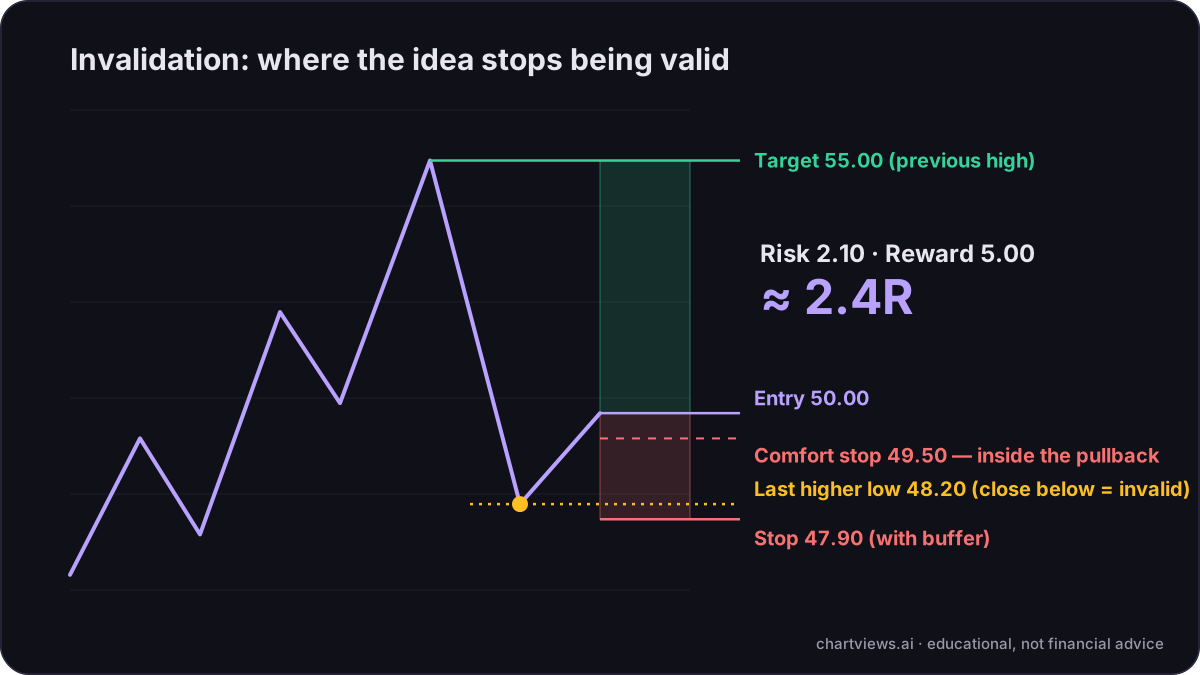
A trader sees a stock that has been rising in steps. After a rally, it pulls back to a zone where the previous breakout started. The idea is: "the uptrend remains intact as long as the last higher low holds." That last higher low sits at 48.20. The entry is at 50.00 after a bullish candle confirms support.
The trade is invalid if price closes below 48.20, because then the sequence of higher lows is broken. With a small buffer for noise, the stop goes at 47.90. The risk per share is 2.10. If the nearest sensible target is the previous high at 55.00, the reward is 5.00, a ratio of about 2.4.
Now consider what happens if the trader had instead chosen a stop at 49.50 just because it felt comfortable. That stop sits inside the normal pullback range, and the trade could be stopped out even though the idea is still valid. Or, if the trader had no stop at all and hoped, a sustained break below 48.20 could turn into a much larger loss, with the original reasoning long forgotten.
Time can invalidate too
Price level is not the only way an idea fails. A breakout setup that goes nowhere for many candles has lost its momentum. Some traders add a time stop: if the expected move has not started within a set number of bars, they exit. A news event, such as an unexpected central bank decision, can also invalidate the premise regardless of where price sits.
Common mistakes
- Placing the stop at an obvious level. Exactly at the round number or the exact swing low, where many other stops sit, makes it a target for sweeps.
- Moving the stop away after entry. Widening a stop to avoid a loss is the single most damaging habit. If the original level was right, honour it.
- Confusing a wick with a close. Decide in advance whether your rule is a touch, a close on your trading timeframe, or a buffer beyond it, and stay consistent.
- A stop that makes the maths impossible. If the real invalidation is far away and your position size does not allow that risk, the answer is a smaller position or no trade, not a tighter stop.
- Having no invalidation at all. "I will see what happens" is not a plan.
What to do after invalidation
Take the loss, record it, and move on. A trade that hit its invalidation level did its job: it limited the damage of being wrong. Review whether the idea was flawed or whether it was reasonable and simply did not work, because even good ideas fail regularly. Do not re-enter immediately out of frustration; wait for a new setup with a fresh invalidation point.
Making it a habit
Before every trade, write down one sentence: "This idea is wrong if ___." If you cannot complete the sentence with a specific price or event, you do not have a trade yet. A structured chart analysis includes the invalidation as the stop-loss in its trade plan, together with the reasoning from structure and liquidity. You can look at one on your own chart by running a free analysis: try it free.
Educational content, not financial advice. Trading involves risk of loss.
 Money Circle Blog
 Trader Reflect Blog