Manual Chart Review vs AI for Traders
A chart that looks obvious at 10:00 a.m. can look completely different after you have checked six more tickers, second-guessed your levels, and missed the move. That is where the real gap in manual chart review vs AI shows up - not in theory, but in speed, consistency, and decision quality under pressure.
For active traders, chart analysis is rarely a one-chart problem. It is a workflow problem. You are scanning multiple markets, watching price react around key levels, and trying to decide whether a setup is clean enough to act on. Manual review can absolutely work, especially if you are experienced. But it also creates friction. AI changes that by turning chart interpretation into a faster, more structured process.
Manual chart review vs AI: what actually changes?
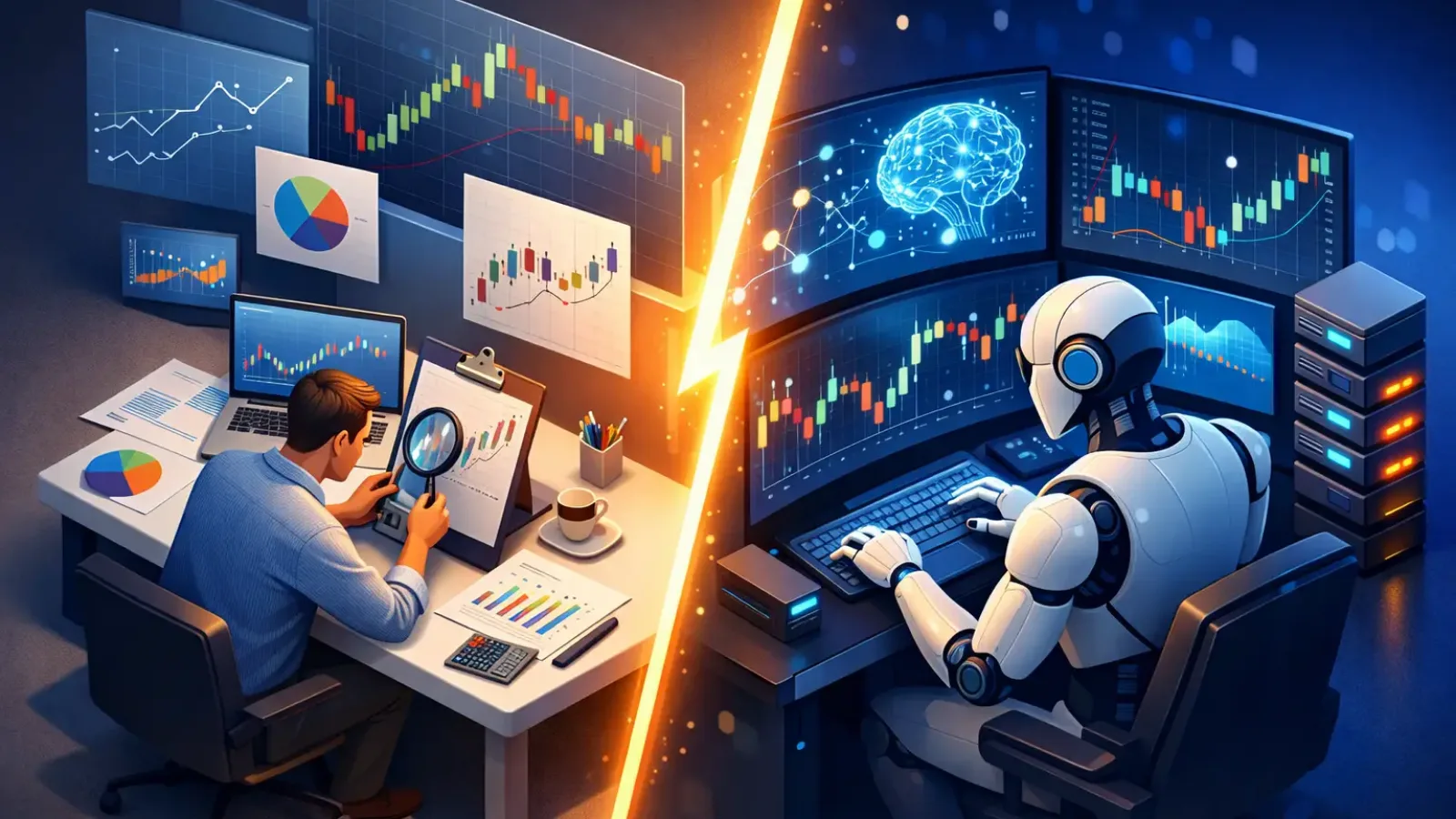
The biggest difference is not that one method is "human" and the other is "automated." The real difference is how each method handles time, pattern recognition, and discipline.
Manual chart review depends on your personal ability to read structure, identify support and resistance, spot trend direction, and judge momentum in context. That can be powerful because a skilled trader can account for nuance. You can notice when a breakout looks weak, when a trendline is being respected but volume is fading, or when a level matters because of recent market behavior rather than textbook theory.
The downside is inconsistency. Your analysis quality can change based on fatigue, emotional state, and available time. A setup reviewed calmly before the open may look different when you revisit it after a losing trade. Manual chart work also gets slower as your watchlist grows. More charts mean more chances to rush, skip detail, or overanalyze.
AI-based chart analysis changes the workflow by processing visual information quickly and returning a structured read on trend, support, resistance, and possible trade zones. Instead of starting from a blank screen every time, you begin with a framework. That matters because many traders do not struggle with seeing charts. They struggle with seeing them the same way every time.
Where manual chart review still has an edge
Manual analysis still matters, especially when market context is messy. A seasoned trader can combine technical structure with broader judgment in ways that a tool may not fully capture. If a chart is sitting near a key level ahead of a major macro event, for example, a human may correctly reduce confidence in the setup even if the chart pattern itself looks clean.
There is also value in building chart-reading skill directly. Traders who manually mark levels and review price action often develop stronger pattern memory over time. That practice can sharpen intuition and improve execution. If you rely only on external signals without understanding why price is reacting the way it is, your decision-making can become fragile.
Manual review can also be better for highly customized strategies. If you trade with very specific criteria, such as a niche multi-timeframe pattern or a combination of structure and market session behavior, you may still prefer to validate setups yourself.
So this is not a case where AI replaces thinking. It is a case where AI can reduce wasted time and improve consistency, while the trader still owns the final decision.
Why AI wins on speed and repeatability
Most retail traders are not short on opinions. They are short on time and process. That is where AI has a clear advantage.
An AI chart analysis tool can review a chart in seconds and return a structured interpretation without hesitation or fatigue. It does not get distracted after three losing setups. It does not drift into bias because of a trade you wish you had taken earlier in the day. It applies the same logic every time.
That repeatability is valuable because trading performance often breaks down at the review stage. A trader may know how to identify support and resistance, but not consistently across ten or twenty charts in a session. They may see the trend correctly on one chart and force a reversal idea on the next. AI helps narrow that gap by creating a more uniform analysis process.
Speed also affects opportunity. In fast-moving markets, the longer it takes to review a chart, the more likely the entry changes or disappears. If you can upload a chart and get immediate technical insight, you can spend less time decoding structure and more time deciding whether the setup fits your plan.
Manual chart review vs AI for beginners and active traders
For beginners, manual chart review can feel overwhelming because every chart seems to present too many possibilities. Is price consolidating or reversing? Is that level meaningful or random? Is the trend strong or already exhausted? Without a structured process, chart reading turns into guessing.
AI helps by reducing ambiguity. It gives newer traders a starting point they can work from, which lowers the barrier to making sense of technical setups. That does not guarantee better trades, but it does create a more disciplined review process.
For intermediate and experienced active traders, the value is different. They often already know how to read charts. Their problem is scale. Reviewing multiple assets, multiple timeframes, and multiple setups every day takes time. AI acts more like an acceleration layer. It can confirm key levels, highlight trend direction, and surface actionable zones quickly enough to support faster execution.
That is especially useful for traders who want to cut down on analysis paralysis. When you have a structured AI read in front of you, it becomes easier to decide whether a setup deserves attention or should be skipped.
The real trade-off: flexibility vs structure
The strongest argument for manual analysis is flexibility. Humans can interpret unusual market behavior, adjust for context, and notice subtle signs that do not fit a rigid pattern. The strongest argument for AI is structure. It reduces variation and makes technical analysis more repeatable.
For most traders, the best answer is not either-or. It is layered decision-making.
Use AI to handle the first pass. Let it identify trend, support, resistance, and likely trade zones. Then apply manual judgment to filter based on your own strategy, risk tolerance, and market conditions. That workflow preserves the speed advantage of AI without removing trader discretion.
This is where tools like ChartViews AI fit naturally. The goal is not to replace your edge. The goal is to cut analysis time, improve clarity, and make each chart review more actionable.
When AI can reduce costly mistakes
A lot of trading errors do not come from bad strategy. They come from inconsistent review. Traders chase because they missed the cleaner setup earlier. They enter late because they took too long to define levels. They force trades because every chart starts to look interesting after an hour of manual scanning.
AI helps by shortening the path between chart and decision. If support and resistance are identified quickly and the trend is framed clearly, you are less likely to improvise. That does not eliminate risk, but it reduces preventable sloppiness.
It can also improve discipline after the market opens. Once volatility picks up, manual chart reading often gets less precise. Traders rush. They anchor to recent price action. They overlook cleaner setups because they are stuck on one chart. AI gives you a faster reset. You can review the chart again with less emotional drift.
Which approach is better?
If you trade occasionally, enjoy doing deep chart work, and have a strategy built around hands-on analysis, manual review may still be enough. If you trade actively, scan multiple setups, or want faster and more consistent technical reads, AI has the stronger practical advantage.
The better question is not whether manual chart review vs AI has one universal winner. The better question is what helps you make clearer decisions, faster, without lowering your standards.
For most active traders, the answer is a workflow where AI handles the heavy lifting of structured chart interpretation and the trader handles execution. That combination is faster than manual review alone and more grounded than blind automation.
The charts are not getting simpler, and the market is not waiting for perfect analysis. The traders who improve fastest are usually the ones who tighten their process first.
Educational content, not financial advice. Trading involves risk of loss.
 Money Circle Blog
 Trader Reflect Blog